Hard-water equipment research
Best water softeners of 2026
We ranked ten of the best water softeners by certified capacity, salt efficiency, service flow, regeneration controls, warranty terms, and ownership demands.

Taylor Rupe·Founder & Editor
B.A. Psychology · B.S. Computer Science · Updated September 4, 2026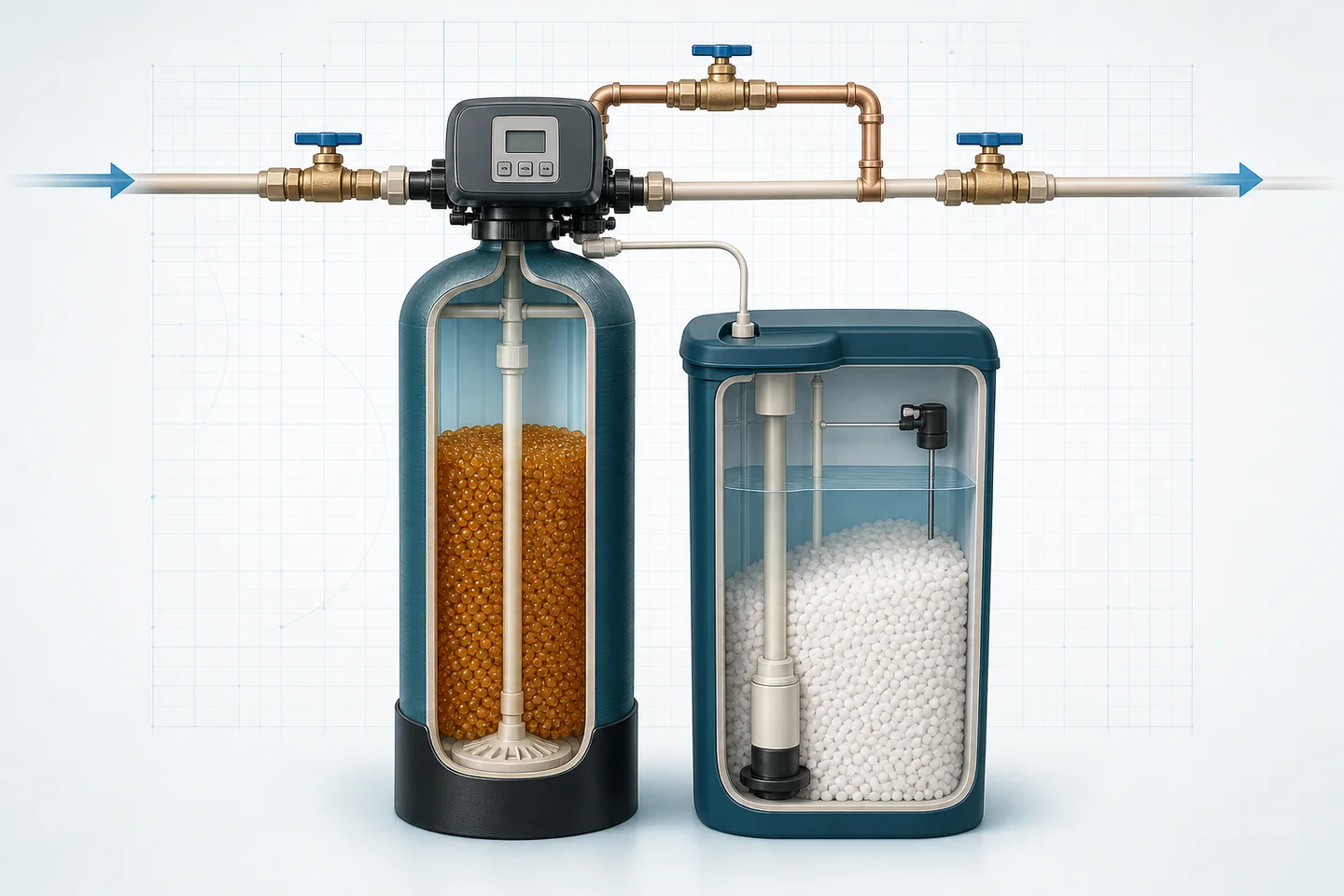
How we chose the best water softeners for 2026
The best water softeners replace hardness ions and document the result at a stated salt dose. Hardness is caused mainly by dissolved calcium and magnesium. A cation-exchange water softener replaces those ions with sodium or potassium, so the treated water tests softer. Most salt-free conditioners target scale behavior without producing the same measured result. [1][5][6]
We rank only exact ion-exchange systems here. The score rewards usable capacity at a stated salt dose, documented service flow, pressure-drop evidence, demand-initiated controls, replacement access, and written warranty terms. A headline maximum grain figure without its salt setting tells you little about day-to-day efficiency. [2][7]
Start with a current hardness test and measured household demand. EPA’s 2026 guide reports that a typical softener can use about 20 to 70 gallons during one regeneration, with larger systems using more, so correct sizing and demand-initiated regeneration affect both salt and water use. [4][6]
The best water softeners of 2026, ranked by certification, flow, and ownership cost
Documentation review
September 4, 2026
This list covers salt-based ion-exchange softeners that remove hardness. Salt-free scale conditioners, including SpringWell FutureSoft, belong in a separate comparison because they do not exchange calcium and magnesium for sodium or potassium ions.
Rank 01 · Best overall documentation
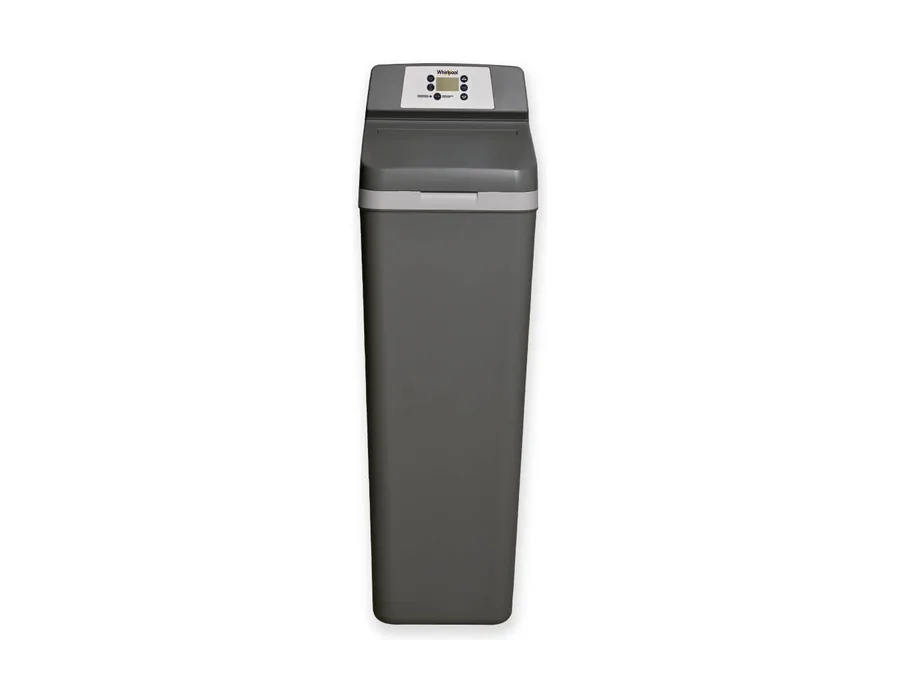
Whirlpool WHES48
Choose the WHES48 if you want exact-model NSF/ANSI 44 verification, transparent salt-dose data, 11.9 GPM rated service flow, and demand-initiated 6th Sense control. Its cabinet holds 1.33 cubic feet of resin, and the rated flow carries a 15 psi pressure drop.
- Certified capacity
- 14,200 @ 2.8 lb; 37,900 @ 10.5; 48,000 @ 18.1
- Rated efficiency
- 5,090 grains/lb; 3.0 gal/1,000 grains
Rank 02 · Best low-water retail cabinet
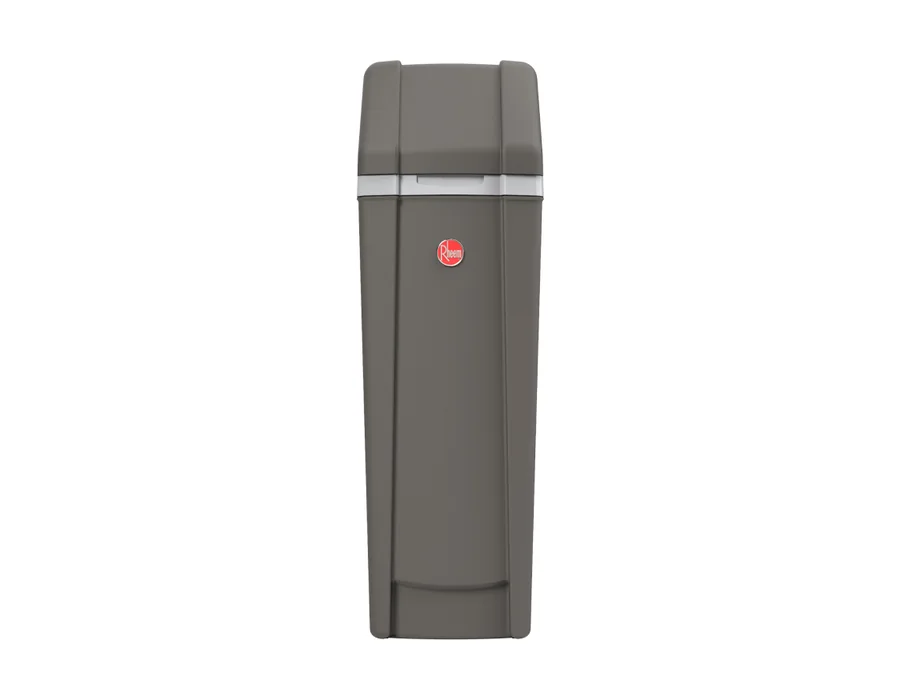
Rheem RHS42
Retail buyers get exact-model NSF/ANSI 44 capacity and efficiency data, a 1.20-cubic-foot resin bed, and a metered learning controller in the RHS42. Its normalized regeneration-water figure is the lowest among the retail cabinets ranked here, but rated service flow stops at 9.9 GPM.
- Certified capacity
- 12,400 @ 2.5 lb; 29,900 @ 8.0; 42,400 @ 16.3
- Rated efficiency
- 5,010 grains/lb; 2.5 gal/1,000 grains
Rank 03 · Best continuous-service design
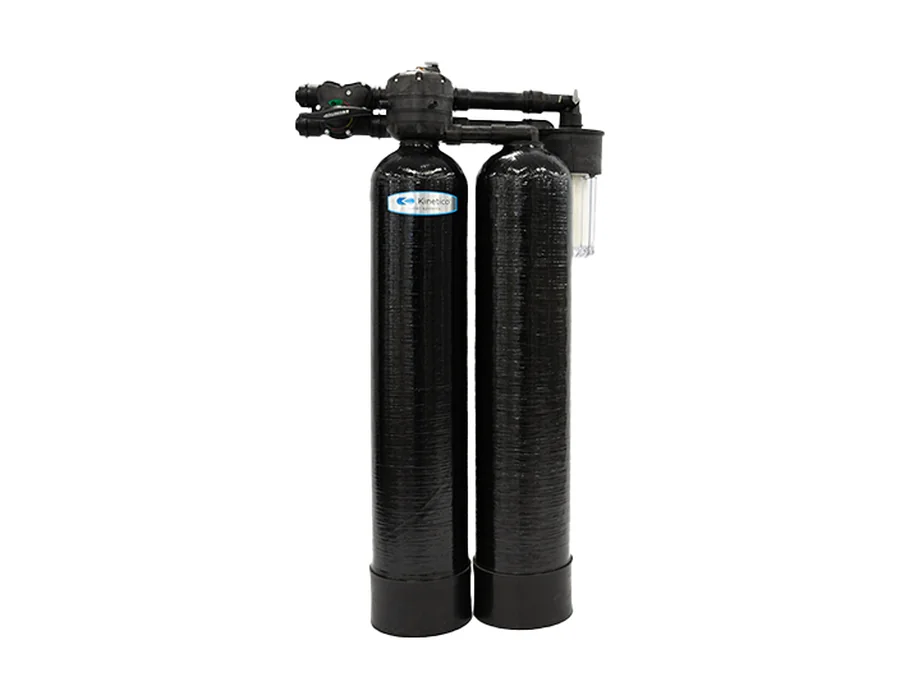
Kinetico Premier XP S250 (product 16532)
For softened water during regeneration, product 16532 has documented WQA certification to NSF/ANSI 44 and twin tanks that alternate under a non-electric metered control with no outlet required. Public performance sheets report different capacities, current total regeneration water is not published, and installed dealer pricing is unknown.
- Later published capacity
- 10,837 @ 2.4 lb; 14,686 @ 4.4 lb
- Published efficiency
- 4,515 grains/lb at 2.4 lb
Why it ranks #1 among the best water softeners: Choose the WHES48 if you want exact-model NSF/ANSI 44 verification, transparent salt-dose data, 11.9 GPM rated service flow, and demand-initiated 6th Sense control. Its cabinet holds 1.33 cubic feet of resin, and the rated flow carries a 15 psi pressure drop.
Retail or DIY buyers whose measured hardness, household demand, and available pressure fit an 11.9 GPM rating with a 15 psi pressure drop.
You want a standard independently serviceable valve-and-tank platform, cannot accept the rated pressure loss, or will not keep cleanser and registration records for extended coverage.
The exact WHES48 appears in NSF's Standard 44 directory with hardness-reduction capacity and efficiency ratings; NSF lists 12 GPM, the rounded form of the manual's 11.9 GPM result. NSF/ANSI 44 certified-product listing WHES48 owner manual and performance data
Certified capacity is 14,200 grains at 2.8 lb of salt, 37,900 at 10.5 lb, and 48,000 at 18.1 lb; maximum rated efficiency is 5,090 grains/lb at the 2.8-lb dose. WHES48 owner manual and performance data
The efficient setting is published at 3.0 gallons per 1,000 grains, while the manual separately lists 44.2 gallons for its maximum-dose regeneration entry; those bases should not be blended into one number. WHES48 owner manual and performance data
The base terms are two years full coverage, three years on electronics, and ten years on tanks. Longer coverage depends on registration and recurring Whirlpool cleanser use, and Whirlpool's model-specific and generic warranty language should be confirmed in writing. WHES48 owner manual and performance data Water-softener extended warranty terms WHES48 official product page
- Certified capacity
- 14,200 @ 2.8 lb; 37,900 @ 10.5; 48,000 @ 18.1
- Rated efficiency
- 5,090 grains/lb; 3.0 gal/1,000 grains
- Rated service flow
- 11.9 GPM at 15 psi drop
- Resin / salt storage
- 1.33 cu ft / 200 lb
View Whirlpool WHES48 score breakdown
Watch: The built-in self-cleaning screen has no published certified micron claim; the manual says the softener does not remove sediment. Treat 11.9 versus 12 GPM as rounding, and obtain the exact extended-warranty terms because Whirlpool's pages do not state them consistently.
Why it ranks #2 among the best water softeners: Retail buyers get exact-model NSF/ANSI 44 capacity and efficiency data, a 1.20-cubic-foot resin bed, and a metered learning controller in the RHS42. Its normalized regeneration-water figure is the lowest among the retail cabinets ranked here, but rated service flow stops at 9.9 GPM.
Households wanting a widely sold demand-initiated cabinet softener with independently documented salt and water efficiency.
Calculated simultaneous demand exceeds 9.9 GPM, local service access matters more than retail availability, or you do not want a cleanser-dependent warranty extension.
The exact RHS42 is listed to NSF/ANSI 44 for hardness capacity, efficiency, and barium/radium 226/228 reduction, with a 9.9 GPM rated service flow. Rheem NSF/ANSI 44 certified-product listing RHS42 owner manual and performance data
Capacity is 12,400 grains at 2.5 lb, 29,900 at 8.0 lb, and 42,400 at 16.3 lb; the maximum certified efficiency is 5,010 grains/lb at the smallest dose. RHS42 owner manual and performance data
Published water use is 2.5 gallons per 1,000 grains at the efficient dose and 45.9 gallons in the maximum-dose regeneration entry; rated service is 9.9 GPM at a 12 psi drop. RHS42 owner manual and performance data
Base coverage is one year full, three years on electronics, and ten years on tanks; extending full coverage to five years requires eligible Rheem cleaner purchases and receipts. RHS42 owner manual and performance data RHS42 Preferred Plus product page
- Certified capacity
- 12,400 @ 2.5 lb; 29,900 @ 8.0; 42,400 @ 16.3
- Rated efficiency
- 5,010 grains/lb; 2.5 gal/1,000 grains
- Rated service flow
- 9.9 GPM at 12 psi drop
- Resin volume
- 1.20 cu ft
View Rheem RHS42 score breakdown
Watch: The 42,000-grain product name is rounded from a certified maximum of 42,400 grains. The self-cleaning screen is not a substitute for a filter with a stated certified micron rating.
Best water softeners #3 · Best continuous-service design
Kinetico Premier XP S250 (product 16532)
View the Kinetico Premier XP S250 Why it ranks #3 among the best water softeners: For softened water during regeneration, product 16532 has documented WQA certification to NSF/ANSI 44 and twin tanks that alternate under a non-electric metered control with no outlet required. Public performance sheets report different capacities, current total regeneration water is not published, and installed dealer pricing is unknown.
Homes that cannot tolerate a hard-water bypass period during regeneration and buyers who value a non-electric twin-tank system.
You need transparent online installed pricing, DIY installation, independently stocked valve parts, or a current public regeneration-water total before purchase.
Kinetico documents WQA certification to NSF/ANSI 44 for softener performance and barium/radium reduction, plus NSF/ANSI 372 and CSA requirements; the contract and tank label should identify product 16532. Kinetico S250 certification and warranty brochure WQA certified-product directory
The later performance sheet reports 10,837 grains at 2.4 lb of salt and 14,686 at 4.4 lb, equal to 4,515 and 3,338 grains/lb respectively, with 11.5 GPM at no more than a 15 psi drop. Kinetico Premier XP performance data sheet, 2024 revision
Each tank contains 0.7 cubic feet of resin, and the hydraulic meter regenerates one tank countercurrently while the other remains in service; current public documents do not state a clear total gallons-per-regeneration figure. Kinetico Premier XP performance data sheet, 2024 revision Kinetico Premier Series XP owner manual Kinetico Premier XP S250 official product page
A 2018 sheet reports higher capacities of 11,276 and 15,399 grains at the same doses. This ranking uses the later, lower values until Kinetico supplies a current exact-model sheet directly. Kinetico Premier XP performance data sheet, 2018 revision Kinetico Premier XP performance data sheet, 2024 revision
- Later published capacity
- 10,837 @ 2.4 lb; 14,686 @ 4.4 lb
- Published efficiency
- 4,515 grains/lb at 2.4 lb
- Rated service flow
- 11.5 GPM at ≤15 psi drop
- Tank configuration
- Twin 0.7 cu ft resin tanks
View Kinetico Premier XP S250 (product 16532) score breakdown
Watch: The score uses the later, more conservative performance table. Total regeneration water and installed price remain unknown publicly; ask the dealer to attach current product 16532 performance, warranty, labor, travel, and price terms to the quote.
Why it ranks #4 among the best water softeners: Installer-channel buyers can verify the NSC42's exact-model NSF/ANSI 44 capacity and efficiency claims against detailed service documentation. Size it from the 9.9 GPM rated service flow at an 11.9 psi drop, not North Star's higher intermittent-flow figures.
Wholesale or installer-channel buyers wanting transparent capacity, water-use, parts, and warranty documentation.
The home's calculated continuous demand exceeds 9.9 GPM, a low pressure drop is essential, or you want longer full-unit coverage.
The NSC42 appears in NSF's current Standard 44 listing for hardness-reduction capacity and efficiency; North Star also identifies NSF/ANSI/CAN 372 and CSA B483.1 compliance. North Star NSF/ANSI 44 certified-product listing NSC42 official product page
Capacity is 12,400 grains at 2.5 lb, 33,300 at 9.5 lb, and 42,100 at 16.3 lb; maximum rated efficiency is 4,940 grains/lb at 2.5 lb. NSC42 current owner manual NSC42 official product page
The efficient setting is published at 2.5 gallons per 1,000 grains and the maximum-dose entry at 45.9 gallons; rated service is 9.9 GPM at an 11.9 psi pressure drop. NSC42 current owner manual
The product page lists 17.8 GPM at a 30 psi drop as intermittent flow. It is not the certified service-flow figure and should not be used for household sizing comparisons. NSC42 official product page NSC42 current owner manual
- Certified capacity
- 12,400 @ 2.5 lb; 33,300 @ 9.5; 42,100 @ 16.3
- Rated efficiency
- 4,940 grains/lb; 2.5 gal/1,000 grains
- Rated service flow
- 9.9 GPM at 11.9 psi drop
- Resin volume
- 1.20 cu ft
View North Star NSC42 score breakdown
Watch: North Star's 17.8 GPM at 30 psi and the manual's other intermittent-flow entries are not the 9.9 GPM rated service flow. The manual also says the unit does not remove sediment, despite broad product-page language about contaminants.
Best water softeners #5 · Best dealer-managed upflow system
Culligan Aquasential Smart HE 10-inch Upflow
View the Culligan Aquasential Smart HEWhy it ranks #5 among the best water softeners: The 10-inch Aquasential Smart HE Upflow fits homes at or below 30 gpg when buyers want connected dealer support, WQA-documented NSF/ANSI 44 claims, 5,105 grains/lb certified efficiency, and an average 20-gallon recharge. Installed price is unknown until quoted, and the contract must name the 10-inch Upflow configuration because other Aquasential configurations use different performance tables.
Homes at or below the configuration's 30 gpg hardness limit whose owners want dealer sizing, installation, monitoring, and service.
Your water is harder than 30 gpg, you want DIY installation or public installed pricing, or the dealer quote does not identify the 10-inch Upflow configuration.
The Aquasential Smart HE Upflow configurations are documented as WQA certified to NSF/ANSI 44 for hardness, barium, and radium 226/228 reduction and to NSF/ANSI/CAN 372; the contract must specify the 10-inch Upflow model. Aquasential Smart HE owner guide and performance tables WQA certified-product directory
The 10-inch Upflow table reports 15,314 grains at 3 lb, 24,999 at 6 lb, and 37,674 at 12 lb, with certified efficiency of 5,105 grains/lb at 3 lb. Aquasential Smart HE owner guide and performance tables
Rated service is 9.4 GPM at a 12 psi drop, not the separate 11 GPM auxiliary-flow figure; the same table gives 1.5 cubic feet of Cullex resin and an average 20 gallons per recharge. Aquasential Smart HE owner guide and performance tables
Culligan's proportional-brining calculation of 5,898 grains/lb at 6 lb is explicitly not an NSF/ANSI 44 rating. This score uses 5,105, and installed dealer price remains unknown until quoted. Aquasential Smart HE owner guide and performance tables Aquasential Smart HE official product page
- Certified capacity
- 15,314 @ 3 lb; 24,999 @ 6; 37,674 @ 12
- Certified efficiency
- 5,105 grains/lb at 3 lb
- Rated service flow
- 9.4 GPM at 12 psi drop
- Average recharge
- 20 gal / 68 min
View Culligan Aquasential Smart HE 10-inch Upflow score breakdown
Watch: Do not mix this model's data with Culligan's 10-inch downflow, municipal, twin, or Softener-Cleer configurations. Warranty coverage is layered by component and can leave freight or local dealer charges to the owner; attach the exact terms and installed price to the quote.
Why it ranks #6 among the best water softeners: The M45C is for retail buyers who want app-based water monitoring backed by exact-model NSF/ANSI 44 capacity and efficiency records and a 10 GPM rated service flow. It uses 4.3 gallons per 1,000 grains at the efficiency setting, and Morton's product-page warranty language conflicts with the manual.
Retail buyers who specifically want Wi-Fi water-use and low-salt monitoring with documented capacity and service flow.
Minimum regeneration-water use is the top priority, you need a rated sediment filter, or you are relying on product-page wording for five years of labor coverage.
The M45C is currently listed to NSF/ANSI 44 for hardness-reduction capacity and efficiency, with a 10 GPM rated service-flow entry. Morton NSF/ANSI 44 certified-product listing M45C owner manual and performance data
Capacity is 13,233 grains at 2.6 lb, 35,700 at 9.9 lb, and 45,400 at 17.2 lb; maximum efficiency is 5,070 grains/lb at the smallest dose. M45C owner manual and performance data
Rated flow is 10 GPM at an 11.2 psi drop. Water use is published as 4.3 gallons per 1,000 grains at the efficiency setting, while the maximum-dose regeneration entry separately lists 43.7 gallons. M45C owner manual and performance data
The manual gives one-year full, three-year board, and ten-year tank coverage, with eligible parts extendable through recurring cleanser use. Product-page 'parts and labor' language is broader than the manual and should not control the purchase decision. M45C owner manual and performance data M45C official product page
- Certified capacity
- 13,233 @ 2.6 lb; 35,700 @ 9.9; 45,400 @ 17.2
- Rated efficiency
- 5,070 grains/lb; 4.3 gal/1,000 grains
- Rated service flow
- 10 GPM at 11.2 psi drop
- Resin / salt storage
- 1.26 cu ft / 200 lb
View Morton M45C score breakdown
Watch: The built-in self-cleaning screen has no published certified micron rating. The 4.3-gallon normalized figure and 43.7-gallon maximum-dose entry have different bases, and Morton's broader product-page warranty wording should be reconciled with the manual in writing.
Best water softeners #7 · Best compact nonchlorinated-water fit
A. O. Smith AO-WH-SOFT-450T
View the A. O. Smith AO-WH-SOFT-450TWhy it ranks #7 among the best water softeners: The compact AO-WH-SOFT-450T belongs on the shortlist for verified nonchlorinated supplies, with connected controls and exact-model NSF/ANSI 44 hardness, efficiency, barium, and radium claims. Its manual limits free chlorine to 0 ppm and rates service flow at 7.5 GPM with a 15 psi drop, which rules it out as a default for chlorinated municipal water.
Verified nonchlorinated water, modest simultaneous demand, and installations benefiting from the 39.5-inch cabinet height.
The supply has measurable free chlorine, peak demand exceeds roughly 7.5 GPM, or the product-page warranty is not confirmed against the manual.
The AO-WH-SOFT-450T appears in NSF's Standard 44 directory for hardness capacity, efficiency, and barium/radium reduction; the current listing rounds service flow to 8 GPM. NSF/ANSI 44 certified-product listing AO-WH-SOFT-450T current owner manual
Certified capacity is 6,510 grains at 1.25 lb, 35,960 at 10 lb, and 45,000 at 18.75 lb. The low-dose result is 5,210 grains/lb; the controller's 21,600-grain high-efficiency setting uses 5 lb, or 4,320 grains/lb. AO-WH-SOFT-450T current owner manual
The manual gives 7.5 GPM at a 15 psi drop, a 26-gallon factory cycle, a 30-gallon high-capacity cycle, 1.25 cubic feet of fine-mesh resin, and a maximum chlorine limit of 0 ppm. AO-WH-SOFT-450T current owner manual
The manual gives five years for mechanical/electronic components and ten years for tanks and cabinet. A. O. Smith's current corporate page instead says three years on mechanical/electronic parts and ten on the main valve and tanks, while its Lowe's product page says five/ten; get the exact terms in writing. AO-WH-SOFT-450T current owner manual AO-WH-SOFT-450T corporate product page AO-WH-SOFT-450T Lowe's-channel product page
- Certified capacity
- 6,510 @ 1.25 lb; 35,960 @ 10; 45,000 @ 18.75
- Rated efficiency
- 5,210 grains/lb at 1.25 lb
- Rated service flow
- 7.5 GPM at 15 psi drop
- Factory regeneration
- 26 gal / 35 min
View A. O. Smith AO-WH-SOFT-450T score breakdown
Watch: Do not recommend this model on chlorinated municipal water without compatible pretreatment or written manufacturer approval. The Lowe's-channel page's '45,000 GPG' capacity label is a unit error: capacity is grains, not grains per gallon. A. O. Smith currently publishes conflicting three/five-year electronics and control-valve terms across its manual and product pages.
Best water softeners #8 · Best straightforward dealer two-tank
EcoWater EEC1502R40
View EcoWater's EEC 1502 seriesWhy it ranks #8 among the best water softeners: Dealer-service buyers can compare the EEC1502R40 through its exact-model NSF/ANSI 44 efficiency table and separate resin and brine tanks with 1.08 cubic feet of resin. Its 9.9 GPM rated service flow carries a 15 psi drop, controls coverage lasts one year, and installed price is unknown until quoted.
Buyers who want a dealer-installed two-tank ion-exchange softener with transparent performance numbers and can obtain a competitive written quote.
A lower rated pressure drop, long valve/electronics coverage, DIY pricing, or an up-front ten-year ownership figure is required.
The EEC1502R40 is listed to NSF/ANSI 44 for hardness-reduction capacity and efficiency and to NSF/ANSI/CAN 372, with a 9.9 GPM rated service-flow entry. EcoWater NSF/ANSI 44 certified-product listing EEC1502R40 official specification sheet
Capacity is 11,700 grains at 2.3 lb, 30,800 at 8.5 lb, and 39,000 at 14.7 lb; maximum efficiency is 5,070 grains/lb at 2.3 lb. EEC1502R40 official specification sheet
Rated service is 9.9 GPM at a 15 psi drop. The sheet reports 3.3 gallons per 1,000 grains at the efficient setting, 38.3 gallons at the maximum regeneration entry, and 56.2 lb/1.08 cubic feet of resin. EEC1502R40 official specification sheet
EcoWater sells through dealers, so installed price is unknown until quoted. The published warranty is ten years on the mineral tank, five on the salt tank, and one on the valve, electronics, and other components, excluding labor. EEC1502R40 official specification sheet EcoWater residential softener and refiner catalog EEC1502 current manual hub
- Certified capacity
- 11,700 @ 2.3 lb; 30,800 @ 8.5; 39,000 @ 14.7
- Rated efficiency
- 5,070 grains/lb; 3.3 gal/1,000 grains
- Rated service flow
- 9.9 GPM at 15 psi drop
- Resin volume
- 1.08 cu ft / 56.2 lb
View EcoWater EEC1502R40 score breakdown
Watch: EcoWater calls the EEC1502 a conditioner, but this exact configuration is an ion-exchange softener, not a salt-free scale conditioner. An older French sheet says 5,100 grains/lb and 14 psi; this ranking uses the current U.S. sheet's 5,070 and 15 psi. Installed dealer price is unknown.
Best water softeners #9 · Best high-capacity dealer option
RainSoft EC5 150 CV
View the RainSoft EC5Why it ranks #9 among the best water softeners: The EC5 150 CV fits dealer-service buyers who need its NSF/ANSI 44-certified 56,600-grain maximum at a 22.5-lb salt dose and 10.4 GPM rated service flow. RainSoft does not publish total regeneration water or installed price, and warranty service can still carry labor, handling, packing, or transportation charges.
Dealer-service buyers who need roughly 10 GPM rated flow and want a documented 56,600-grain maximum at its stated high salt dose.
You require transparent installed pricing, a published total gallons per regeneration, or a lifetime warranty without labor, handling, or transportation exclusions.
The exact EC5 150 CV is listed to NSF/ANSI 44 for hardness capacity, efficiency, and barium/radium 226/228 reduction, with 10.4 GPM rated service flow. RainSoft NSF/ANSI 44 certified-product listing EC5 owner manual and certification performance sheet
The certification performance sheet gives 22,400 grains at 4.5 lb, 48,500 at 15 lb, and 56,600 at 22.5 lb, with 4,970 grains/lb at the smallest dose. EC5 owner manual and certification performance sheet
Rated flow is 10.4 GPM at a 15 psi drop with 1.5 cubic feet of resin. The reviewed public table does not publish total gallons per regeneration, so water cost is unresolved rather than estimated. EC5 owner manual and certification performance sheet
An earlier operational table in the same manual reports 21,400 grains and 4,750 grains/lb at 4.5 lb. This ranking uses the exact certification sheet's 22,400 and 4,970 values, while installed price and possible warranty service charges remain dealer-specific unknowns. EC5 owner manual and certification performance sheet EC5 official product page
- Certified capacity
- 22,400 @ 4.5 lb; 48,500 @ 15; 56,600 @ 22.5
- Certified efficiency
- 4,970 grains/lb at 4.5 lb
- Rated service flow
- 10.4 GPM at 15 psi drop
- Resin / water use
- 1.5 cu ft / regen gallons not published
View RainSoft EC5 150 CV score breakdown
Watch: Use the certification performance table rather than the older operational table, and verify that the dealer's tank label says EC5 150 CV. Total regeneration water and installed price are not public; lifetime parts language can still leave labor, handling, packing, transportation, or price-increase charges.
Best water softeners #10 · Best direct-sales two-tank alternative
SpringWell SS1
View the SpringWell SS1Why it ranks #10 among the best water softeners: The SS1 fits direct-sales buyers who want a salt-based ion-exchange softener with separate resin and brine tanks and a published 11 GPM service figure, not the salt-free FutureSoft conditioner. No exact SS1 system listing was found in the reviewed NSF or WQA directories, and public documents omit salt-dose capacity, grains-per-pound efficiency, regeneration water, pressure drop, and resin quantity.
Direct-to-consumer buyers who prioritize the published 11 GPM service figure and separate-tank layout over third-party performance documentation.
Exact NSF/ANSI 44 system certification, verified grains-per-pound efficiency, California efficiency documentation, or predictable regeneration-water cost is mandatory.
SpringWell identifies the SS1 as a salt-based ion-exchange softener with 32,000-grain nominal capacity, an 11 GPM published service flow, one-inch connections, and a 25–80 psi operating range. SS1 official salt-based softener page Current SS1 installation instructions
No exact SS1 system listing was located in the current NSF or WQA product directories reviewed for this edition. That is a documentation finding, not evidence that the unit fails to soften water or that no individual component is certified. NSF Standard 44 certified-product directory WQA certified-product directory
The reviewed public documents do not provide a salt-dose capacity curve, grains-per-pound rating, total regeneration gallons, rated pressure drop, or resin quantity; PNNL recommends demand-initiated softeners with current NSF/ANSI 44 efficiency ratings where efficiency is the purchasing goal. SS1 official salt-based softener page Current SS1 installation instructions Building America water-softener efficiency guidance
The current product table says 11 GPM and one-inch connections, while other sizing or older installation material has shown 9 GPM or three-quarter-inch references. Confirm the shipped valve, written warranty, and installed-return terms before purchase. SS1 official salt-based softener page Current SS1 installation instructions Earlier SS1/SS4 installation PDF
- Nominal capacity
- 32,000 grains; no dose curve published
- Published service flow
- 11 GPM; pressure drop not published
- Connection / pressure
- 1 inch / 25–80 psi
- Efficiency / water use
- Not publicly documented
View SpringWell SS1 score breakdown
Watch: The documentation penalty is not a claim that the SS1 cannot soften water. Do not place SpringWell FutureSoft in this ranking: it is a salt-free scale conditioner. For the SS1, exact-system certification, salt efficiency, regeneration water, pressure drop, resin quantity, and internally consistent connection/flow terms remain unresolved.
Scores use the Water Filter Report weights: hardness fit 30, independent verification 25, ownership burden 20, household fit 15, and terms and support 10. This is a documentation review dated September 2, 2026, not a hands-on laboratory test. Capacity is tied to its stated salt dose, rated service flow is kept separate from peak or intermittent flow, and every water-use figure retains its published basis. Dealer pricing is marked unknown rather than estimated, and certification applies only to the exact claims and configurations listed. Read the complete scoring method.
Which certifications matter for a water softener?
This is the central residential cation-exchange softener standard. Exact listings can cover capacity, rinse effectiveness, brine accuracy, pressure drop, efficiency, materials, and structural integrity. [2]
This standard addresses health effects from materials and components that contact drinking water. It does not by itself prove hardness reduction or a specific softening capacity. [3]
This standard addresses lead content in drinking-water components. It is a material claim, not evidence that a softener removes lead or any other contaminant from the incoming water. [3]
What should you check before buying a water softener?
The quote should connect the exact model to your water result and peak demand. Ask for the certified capacity at each salt dose, regeneration gallons, rated service flow, pressure drop, drain requirements, and the control settings the installer will use. [2][4][7]
- What is the tested hardness in grains per gallon, including any iron or manganese adjustment?
- What continuous and peak service flow does the household require?
- Is usable capacity stated at an efficient salt dose rather than the maximum advertised grain number?
- Does the control valve meter actual usage and permit sensible regeneration programming?
- What are the annual salt, water, electricity, cleaning, and service requirements?
- Is this an ion-exchange softener, a conditioner, or a hybrid, and are its claims described accurately?
Use the ranking responsibly
Which of the best water softeners fits your hardness and flow?
The best water softeners for your home still have to fit its measured hardness, iron and manganese conditions, service-flow requirement, available drain, and local brine rules. Keep an unsoftened drinking tap if that fits household needs, and verify performance with a treated-water hardness test after commissioning. [6][4][1]
Before signing the installation quote, ask the seller to write down the programmed salt dose, capacity at that dose, expected regeneration interval, regeneration-water volume, and rated service flow. Compare those settings with the exact NSF/ANSI 44 record and keep the first treated-water hardness result with the manual. Recheck the setting if household occupancy, water chemistry, or peak demand changes, because the best-scoring model on paper can still be a poor fit when it is programmed for a different load. [2][4][7]
Read our complete methodologySources / Documents reviewed
Water-softener standards and sizing sources
Each number opens the source used for the nearby claim. We link to the issuing organization or original publication whenever it is available.
- 1 Hardness of Water U.S. Geological Survey · Government
- 2 NSF/ANSI 44 Technical Requirements NSF · Certification body
- 3 NSF Standards for Water Treatment Systems NSF · Certification body
- 4 WaterSense Guide to Cation Exchange Water Softeners U.S. Environmental Protection Agency · Government
- 5 Ion Exchange Treatment of Drinking Water Water Quality Association · Industry technical
- 6 Household Water Treatment: Water Softening Virginia Tech Cooperative Extension · Academic
- 7 Water Softeners PNNL Building America Solution Center · Government